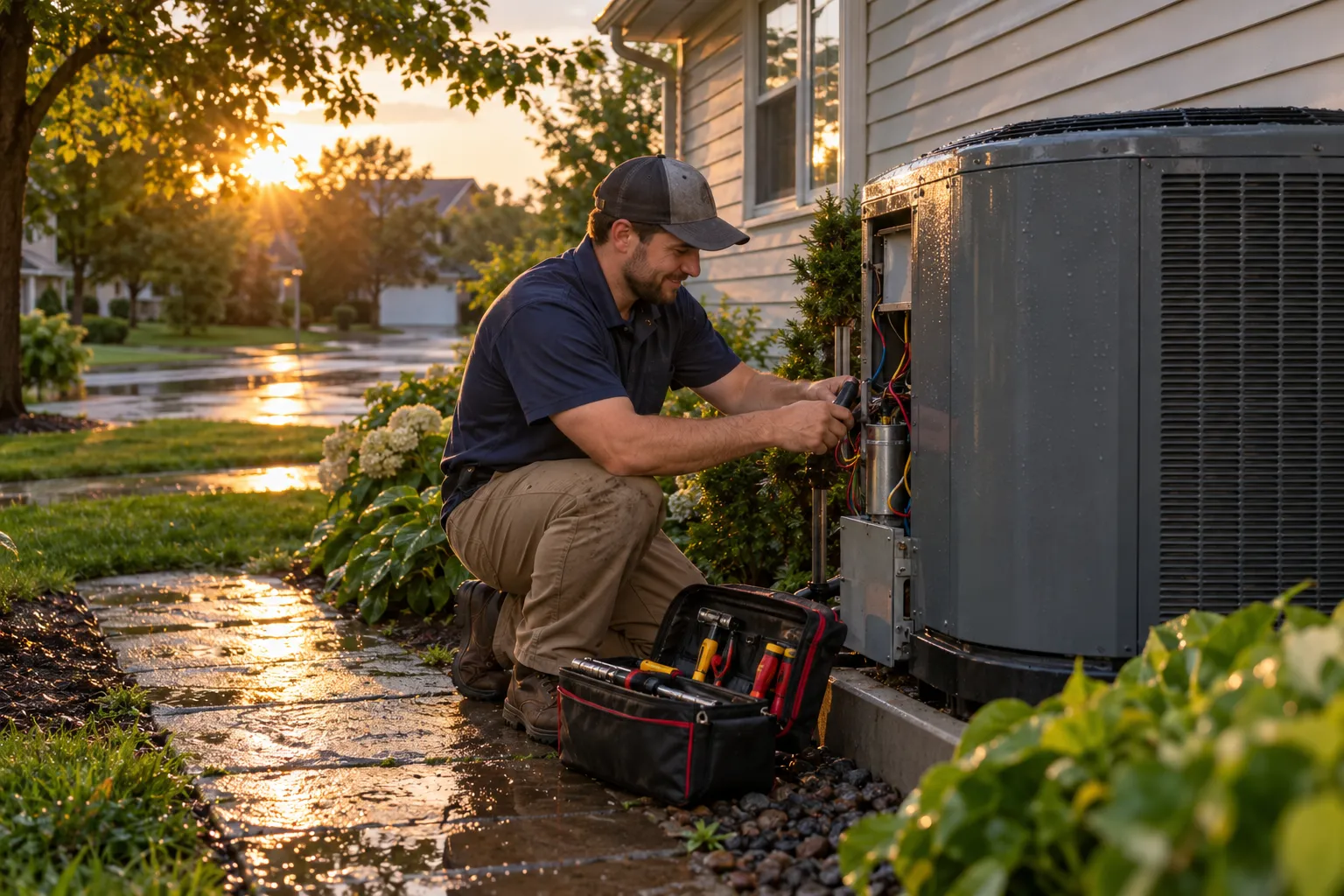
Need ac installation and replacement in Charlotte?
Tell us what your system is doing and where you are. Mountedweak Heating & Air will pass your request to a local provider in our network. No obligation.
No obligationRequest an estimate from a local provider
Many homeowners believe an AC should be fixed until it dies. In practice, a worn-out unit can cost more to patch each summer than a new one costs to run. If your system is old, loud, or struggling in the humid heat, it may be time to compare options.
Mountedweak Heating & Air is a referral service. We do not install anything ourselves. We connect homeowners in the Charlotte area with independent providers in our network who handle sizing, installation, and startup. You can ask questions, compare written quotes, and decide with no obligation. This page explains the signs, the system types, the sizing, and the questions worth asking before you say yes.
A lot of people think a warm house always means a small repair. Sometimes it does. But when the unit is old, noisy, and costs more every summer, a replacement can be the smarter move.
If your AC just quit in a heat wave, start with a repair visit. Emergency AC repair is often the right first step, and a provider can tell you whether the fix is small or the unit is past saving. Request a callback to check provider availability in your area.
No single sign decides it. Look at the whole picture:
Two or three of these together are a good reason to ask for a replacement estimate.
Here is a common belief: "Only a pro can look at an AC." Not quite. You can do a few simple things before anyone visits. Check, then call.
That is where the homeowner's part ends. Opening panels, handling refrigerant, and working with wiring need trained hands and proper tools. Refrigerant work also has legal rules in the U.S.
Most homes use one of a few setups:
A provider can explain which one fits your house and budget.
Myth: a bigger AC cools better. In practice, an oversized unit cools the air fast and then shuts off. That short cycling leaves moisture behind, and in a hot, humid summer you feel it. It also wears parts faster.
A careful provider does a load calculation. That looks at square footage, insulation, windows, ceiling height, and sun exposure. Older mill-era houses and newer subdivision homes can need very different sizes, even at the same floor area. Foundation type, such as a crawl space or a slab, and the siding also affect the answer. Guessing from the old unit's label is not enough.
A full replacement usually covers more than swapping a box. Ask whether the quote lists each step:
This is not a weekend project. Refrigerant, high-voltage wiring, and charge testing all call for a trained provider.
An outdoor unit and indoor coil should be made to work together. Mixing old and new parts can cut performance and may cause trouble with warranty terms. Ask the provider to confirm the match in writing.
Also ask about your ducts. Leaky or crushed ducts waste cooling, no matter how new the unit is. If you are also searching furnace replacement near me, mention it. Some homeowners pair both jobs, though each is its own project with its own quote.
You will see a number called SEER2 on newer units. Higher means the system uses less electricity to make the same cooling. A higher number usually costs more up front, so the question is how long the unit runs each year. In long, humid summers, the extra efficiency can pay back faster.
Ask the provider to show two or three options side by side, with the price and the expected running cost for each.
If an answer is vague, ask again. A written quote makes comparing easier.
A new AC is not maintenance-proof. Change the filter on schedule, keep plants and mulch back from the outdoor unit, and rinse off dirt gently with a garden hose. Schedule yearly HVAC service so a provider can check the charge, coil, and drain line before summer.
Thunderstorms and the occasional ice storm can stress outdoor equipment. Ask whether a surge protector makes sense, and clear fallen branches when it is safe. Keep your paperwork in one place for warranty needs.
The provider measures your home and its heat gain so the new system is sized for it.
Refrigerant is recovered and the worn-out equipment is hauled away properly.
Outdoor unit, indoor coil, lines, drain, and wiring are installed and connected.
Airflow, charge, and thermostat settings are checked before the job is closed.
Prices vary by home, system type, and region. These are typical U.S. ranges, not quotes. Ask each provider for a written quote that lists equipment, labor, and any extras.
| Item | Typical range | Notes |
|---|---|---|
| Central AC replacement | $5,000 – $12,000 | Outdoor unit, coil, and install |
| Heat pump system | $6,000 – $14,000 | Cools and heats |
| Ductless mini-split (one zone) | $3,000 – $7,000 | Each added zone costs more |
| Outdoor unit only | $2,500 – $6,500 | Only if the coil is a match |
| Thermostat upgrade | $150 – $600 | Smart models cost more |
| Ductwork repair or changes | $500 – $3,000 | Depends on access and damage |
Look at the thermostat, breaker, filter, and outdoor unit to rule out simple causes first.
Tell us about your home and system, and we pass it to a provider.
Review size, equipment, and what is included, then ask your questions.
The provider installs the system. Then keep up filters and yearly service.
We explain what is true about aging ACs so you can decide calmly.
Know which checks are safe for you and which need a trained provider.
You are matched with independent providers who work in your part of the area.
Request an estimate, compare, and choose. There is no obligation to proceed.
Tell us what your system is doing and where you are. Mountedweak Heating & Air will pass your request to a local provider in our network. No obligation.
No obligationAge, repair history, and efficiency all matter. If the unit is over 12 years old and repairs keep adding up, ask a provider to compare both options.
Many installs take a day or two, though ductwork changes, permits, or a complex setup can add time. Your provider can give a timeline in the written quote.
Normal wear is usually not covered. Some policies may cover sudden damage, such as storm or lightning harm, so check your policy. Providers can often help document damage for a claim.
Tell us what your system is doing and where you are. Mountedweak Heating & Air will pass your request to a local provider in our network. No obligation.
No obligation